Venezuela
Data Highlights
- Recorded Venezuelan movements have shifted, with Colombia's regular entries rising 20% in 2024 over 2023 and remaining 40–70 % higher during the first quarter of 2025.
- Regular entries of Venezuelans to Ecuador declined 72% in 2024, and Mexico saw an 18% drop; both countries stayed below their 2024 levels in early 2025.
- Irregular entries of Venezuelans have overall decreased in Mexico they fell to 3,478 in February 2025, the lowest monthly total since mid-2022. In contrast, regular entries to Colombia and Brazil have increased, suggesting more migrants are turning to formal channels and nearer South-American destinations.
- Between January 2022 and March 2025, Brazil (+375,000) and Colombia (+61,500) registered the largest net flow of Venezuelans, marking them as the top destinations for Venezuelan nationals.
In recent years, the displacement of Venezuelan nationals has constituted one of the most significant and complex migration dynamics in the Americas, with far-reaching humanitarian and policy implications. As of December 2024, over 7.89 million Venezuelans have left their country, constituting one of the largest displacement crises globally. Understanding the evolving patterns and dynamics of Venezuelan mobility across the region is crucial for informed policymaking and effective humanitarian responses. To better understand these evolving dynamics, the following analysis draws on the consolidated administrative data to map recent shifts in Venezuelan mobility patterns.
Patterns of Venezuelan mobility across the Americas
Regular entries represent movements recorded through official administrative procedures and therefore do not account for irregular migration. Entry data reflects movements rather than unique individuals; therefore, a single person entering a country multiple times is recorded each time. While these limitations are important, administrative data are a critical source due to their timeliness, consistency, and geographic coverage, allowing for frequent analysis of mobility shifts across countries.
Two notable trends emerge from an analysis of regular entries by Venezuelan nationals in the Americas:
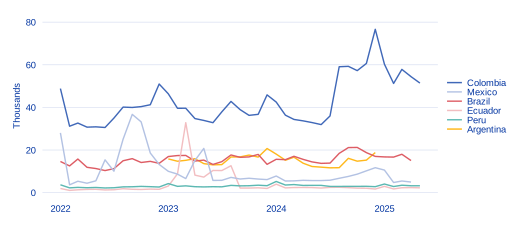
Within 2022 and 2025 (the coverage period of the data), several countries experienced significant increases in the number of entries by Venezuelan nationals. Mexico exhibited a distinctive entry pattern, following relatively stable entry levels throughout the first semester of 2024 Mexican administrative data show a marked increase in regular entries, beginning in July 2024, peaking sharply in December 2024 with approximately 11,600 recorded entries, the highest monthly count observed for that year. Such a sudden and pronounced rise is atypical if considering the entry patterns of previous years.
While motivations for movement cannot be confirmed from administrative data alone, these movements coincided with the anticipated return of U.S. President Donald Trump known for stricter immigration policies and intensified border enforcement. Following the implementation of stricter U.S. border policies and increased deportations under the Trump administration, the number of Venezuelan nationals entering Mexico declined sharply. Venezuelan migrants, unable to enter the United States, are now returning southward, marking a shift in migration patterns due to these policy changes. This change can also be observed in the data: after peaking in December 2024, entries fell to around 4,7k by February 2025, aligning with levels observed prior to mid-2024.
To further contextualize these shifts the following compares Venezuelan entries in 2024 to 2023 across several countries:
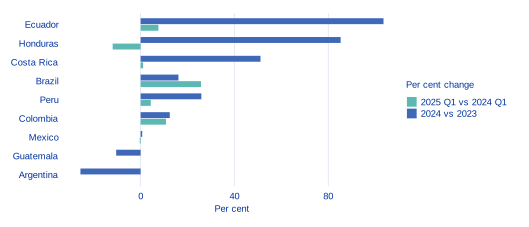
Colombia registered the largest annual increase in regular Venezuelan entries in 2024 compared to 2023 (+94,979; +20%). Costa Rica and Guatemala each grew by roughly +19% (about +2,100 and +1,100 entries, respectively). Peru (+6%) and Brazil (+5%) recorded more modest gains. By contrast, Ecuador posted the steepest decline (-73,425; –72%), while Mexico (-18,786; –18%) and Argentina (-13,768; –7%) also saw notable decreases. Overall, data indicates that a growing share of Venezuelan regular movements are captured in Colombia and neighboring destinations, whereas regular entries in Ecuador and Mexico have fallen markedly.
Early 2025 figures reinforce this redistribution. Colombia's entries rose sharply in Q1 of 2025 compared to Q1 of 2024 +42% in January, +41% in February and +68% in March. Brazil continued to show steady single-digit increases (6–8 % per month). Honduras remained broadly unchanged. Mexico's January entries were still +36 % higher than a year earlier but dropped below 2024 levels in February (–13%) and March (–1%). Ecuador, Costa Rica and Peru showed consecutive monthly declines ranging from 4% to 26%. These patterns confirm that Colombia's share of recorded arrivals continued to expand in 2025, while regular entries to Ecuador and Mexico remained reduced.
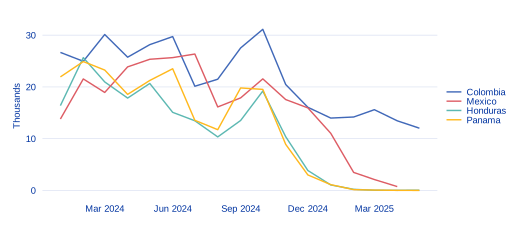
Finally, examining irregular entry data from available countries offers additional insights into changes in movement dynamics. While overall irregular entries of Venezuelan nationals have decreased in the last two years, regarding irregular entries to Mexico, they have reached their lowest levels since mid-2022, where in February 2025 crossings were 3,478. The same is true for Panama, where irregular entries through the Darien have reached their historical lowest levels in the last 3 years reaching 151 in February 2025. The simultaneous decline in irregular entries and rise in regular entries within South America suggest that mobility patterns may be changing in structure and shifting towards more formal channels and/or nearer destinations within South America. A shift that aligns with stricter regional immigration measures and the broader increase of north-south flows documented in recent regional reporting from IOM.
Where are Venezuelan's staying?
Understanding not only where Venezuelan nationals are moving, but also where they are staying, requires a different lens. While regular entries measure border movements, the accumulated net flow, calculated as the cumulative difference between regular entries and exits, offers insight into the evolving distribution of migrant presence across countries in the region.
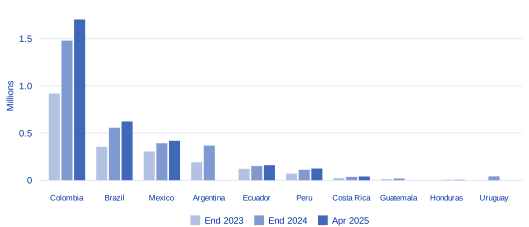
Since January 2022, three countries have emerged as key destinations for Venezuelan migrants based on net accumulation figures. Brazil recorded the highest net flow, with more than 375,000 entries exceeding exits. Colombia followed with approximately 61,500, and Ecuador with 38,500. While these figures do not directly measure long-term settlement, they point to sustained regular mobility into these countries over time, highlighting the persistent relevance of these destinations for Venezuelans navigating ongoing displacement, return limitations, and regional shifts in migration policy.
Peru presents notable decreases in its accumulated net flow of Venezuelans, having decreased by approximately 60,000 over the past three years. Typically, if Peru were serving as a transit country, one would expect entries and exits to roughly balance each other out, resulting in minimal change in accumulated migrant stock. However, the consistent downward trend observed since 2021 may suggest that Peru may no longer be key destination for Venezuelans.